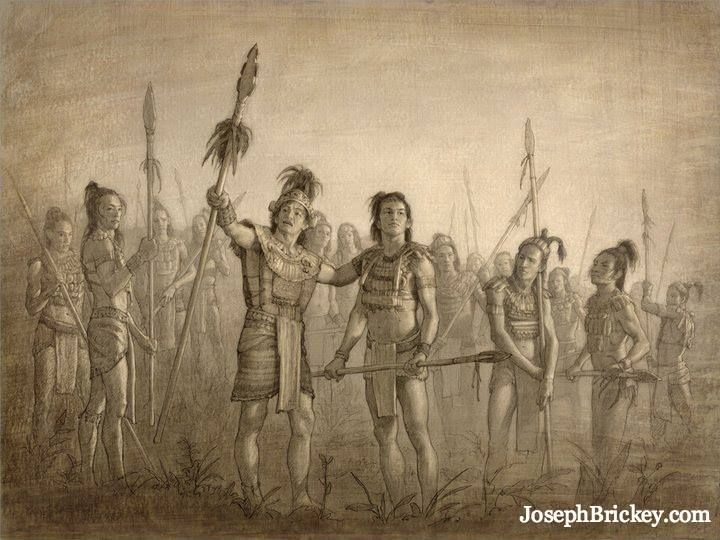
Why do members of the church of Jesus Christ of Latter-day Saints think that they face battles every day? President Brigham Young said, “the men and women, who desire to obtain seats in the celestial kingdom, will find that they must battle every day (in Journal of Discourses, 11:14).?” Members of the church believe that we are children of God and the adversary attack us to make us miserable as he is. For that reason, the Lord God provided us with a guide to conquering eternal life by giving us the Book of Mormon in which mankind can find different examples to overcome spiritual battles. One of the examples that I love is the stripling warriors who were young soldiers, 2,000 in number, and were victorious even when they did not have experience in the battle. The reasons for their success are based on: 1. They made a covenant with God “that they never would give up their liberty, but they would fight in all cases to protect the Nephites and themselves fro...
Posts
- Get link
- X
- Other Apps
Human beings are children of God. One of the doctrines learned in The Church of Jesus Christ of Latter-day Saints is that all mankind are children of God. In 1995 in “The Family: A Proclamation to the World,” explained in detail this doctrine “All human beings—male and female—are created in the image of God. Each is a beloved spirit son or daughter of heavenly parents, and, as such, each has a divine nature and destiny.” And the proclamation mentioned three times “His children” and two “son-daughter” to point out this doctrine. If human beings could see as brother and sister, there is no racism, racial segregation, classism, or any kind of discrimination worldwide. The doctrine that we are children of God teaches us to love one another and help others in need. President Oaks remembered us in October 2021 what are the things that members of the church make to help others. One of the practices of membership is to fast at least on the first Sunday of the month and contribute w...
05/31/2121; Week 7 Culture and Psychology
- Get link
- X
- Other Apps
Culture creates "ought self" for genders, children, races, and ages. APA Dictionary of Psychology describes “ought self is a mental representation of a set of attributes that one is obligated to possess according to social norms or one’s personal responsibilities” In Mexico, we have some expressions that exemplified women and men where men have to be strong. These ideas are sexist and we called in Mexico “machismo”. “Los niños no lloran solo las Viejas” Men do not cry only women “Corres como niña, tiras como niña” Run like girl, throw like girl. “Este trabajo es para hombres” This job is for men. “Vieja el último” You are a lady if you arrive at the end. “No seas nenita” Stop being a little lady “Peleas como niña” Fight like a girl The meaning of “vieja” is an old woman but in this situation is to debunk the woman because women are weak and they born to be housewives. “Tenías que ser mujer” You have to be lady. “Calladita te ves más bonita” Be quiet you ...
5/29/2021 Differences in Manners
- Get link
- X
- Other Apps
The Dictionary of Cambridge explains the word of manners by explaining “A way of behaving with other people. The way in which a person talks and behaves with other people. The way something happens or something is done. Socially acceptable ways of behaving.” This meaning change when are defining the culture where you are. For this reason, some manners are considered bad or good. For example in Japan is offensive to check your cash when the cashier gives the money because they are honest but in America is normal to do because sometimes the cashier gave more or less. Chewing with your open mouth in America is considered bad manners but in some countries of Asia is normal to hear slurping noodle and have your mouth full. Eating with your hand is common in some countries as Ethiopia and Morocco but in other countries used silverware or chopsticks. There are many examples of different points of view for good or bad manners but this misconception is how to watch the word. Ren...
05/28/2021 Cross-Cultural Students in the Classroom
- Get link
- X
- Other Apps
What are the differences to have Cross-Cultural students in the Classroom? There are many examples of the differences between cultures. For example, when you have Asian students in the classroom they are not participative in the classroom, they are less expressive and they speak in a low tone. They do not have a disagreement with the teacher because they believe that behavior is unrespectful. On the other hand, Hispanic students have more expressivity when they speak to the teacher. They make more jokes during the class. American students arrive late to the class and they do not apologize to the teacher for the delay. African students are more active than white students. We have many differences depending on who is watching even if you do not have Cross-Cultural students in your classroom you will have differences. I had an experience, many years ago when I was at the Art University in Mexico, I had an interdisciplinary class in which I had two teachers one of them was a young ...
5/26/2021 Attributional Tendencies
- Get link
- X
- Other Apps
Some cultures refer to success to themselves and most cultures oriented individualism attributes their success because they have excellent abilities or skills and they are winners. Besides, they have the things that they had because they work hard to achieve this goal. On another hand when they have misfortune they blame others for their failure they attribute bad luck to their lives but they are not responsible for this failure. Other cultures oriented collectivism attributes their failures to themselves by blaming them for their mistakes. However, when they have achievements recognize the importance for others like family, teachers, or team. “Internal Attributions ascribe the causes of behavior to personal dispositions, traits, abilities, and feelings.” “External Attributions ascribe the causes of behavior to situational demands and environmental constraint.” As an ESL teacher is precise to observe the students and recognize how they understand the attribution for succes...
5/26/2021 Personal Space Differences.
- Get link
- X
- Other Apps
Personal space differences will change with strangers, family, friends, boss, coworkers, or with our love. You can divide by closer or larger personal space. For example, our family, friends, and love have closer personal space and we feel comfortable with them. However, with strangers, employees, or boss this personal space changes and it is larger because if they approach us we see them as intruders. Besides, culture, situations, gender, ages, and emotions create other personal space differences. Another example of personal space where is changed by situations is transportation. In Mexico City change when you are in the subway and most when it is rush hour and people are pushing each other into the wagon, not matter if you are a woman or a man. Children do not have personal space because personal space is learned around 12 years. By gender, the women create longer personal space to men coworkers and most the married women not to create sexual misunderstandings. Culture has ...
5/24/2020 Individualism vs. Collectivism
- Get link
- X
- Other Apps
Values between Culture Oriented to Individualism or Collectivism “…a culture oriented to individualism might highly value being able to work independently, while a culture oriented to collectivism might highly value being able to work as part of a group.” “…people who grow up in a collectivistic culture are likely to give very high priority to their social relationships and to have strong feelings of affiliation with, concern for, and obligation to members of their group. These feelings tend to lead people to develop goals that are more group-oriented than self-oriented” “…family members in a collectivistic culture may desire or feel obligated to care for relatives in need, so accepting help from others may be viewed as evading family responsibilities (Boone, 1992).” Culture Oriented to Individualism work together to achieve their goals because they belong to a group, family, or tribe in which their decisions damage or help their group. In many times their decisions are taken for ...
5/24/2021 Differences in Emotional Expressivity
- Get link
- X
- Other Apps
Humanity feels the same emotions but how to express them in many cases is based on their culture. Some cultures show low expressivity because they do not let themselves express their emotions in public and private situations. Other cultures show high expressivity in where they can be able to demonstrate their emotions in an effusive way. Hispanic permit themselves to demonstrate high expressivity and sometimes this behavior could be considered rude, boring, ridiculous, and dumb for others cultures whereby cultural emotional expressions could create misunderstandings. One of these behaviors is for Mexican birthdays, Mexicans celebrate birthdays with a cake, and the guests yell “Queremos pastel” (we want a cake, in English) and they hit the table at the same time they are yelling. Next step, people sing “Las mañanitas” a traditional song and the birthday boy/girl blows the candle. After this, all people yell a cheer called “A la vio a la vao” , and at the end, we have “Mordida” ...
5/20/2021 Cultural Miscommunication
- Get link
- X
- Other Apps
There are many communication patterns in the world and many of them could create miscommunication. Affective expressions, gestures, manners, and personal space are some patterns and in one culture have a meaning but in another country are so different. These cultural miscommunications would create fun situations or embarrassing situations. One story that I loved because illustrates cultural miscommunication was written for the Mexican journalist Jorge Ibargüengoitia when he described the foreign bathroom and the descriptions for using water. For example, the English language uses the letter “C” for cold water and “H” for hot water but for Spanish speakers use the letter “C” means hot (caliente, in Spanish) and letter “F” for cold (fría, in Spanish) and in other countries uses color then red is for hot and blue is for cold. The problem was solved but what happened when you have more than one handles in the bathtub. He had one experience about this when he visited Madrid. He wanted...
5/18/20121 Cultural Differences Concerning Time
- Get link
- X
- Other Apps
In the world we use the Gregorian calendar to standard the time with 365 days per year, with 12 months, 7 days per week, one day has 24 hours, one hour has 60 minutes, and 60 minutes has 60 seconds. However, the world has the same time but the perception for the time is based on our culture and some cultures create their schedules based on the importance of work, activities, family, business, social life, religion, and seasons. There are many cultural expressions to explain the perception of time: Punctual like a British “In Britain, people make a great effort to arrive on time, so it is impolite to be late, even by a few minutes.” 1 American Time “Americans may believe that all paid time on the job must be productive.” 2 Hora Mexicana “Which treats time considerably more casually” 3 Indian Time “Things happen when they happen” 4 These expressions exemplified the interpretation that cultures have for the time and we need to pay attention when we visit another country because ...
5/17/2021 The ugly unicorn - Culture Paradigms
- Get link
- X
- Other Apps
The interpretation of the world is based on our background for the culture in which culture has an important role in our paradigms and standards. One example of this was the explores Marco Polo in his travels through Asia. He saw a rhinoceros and he did not know about them, but in his background were the readings for mythical animals then he described the rhinoceros-like- unicorn and he said... "They had a black horn in the middle of their heads that could only be described as being similar to a boar. He also noted that they enjoyed basking in mud and slime – a far cry from the pure nature that was characteristic of the beast at the time." By this experience, Marco Polo assumed that the rhinoceros was an ugly unicorn and we are like him when we created our assumptions about what is beautiful, ugly, wrong, correct, healthy, illness, etc. based on our culture to make assumptions and interpretations. Our culture provided us identity but when cultural differences create confli...
- Get link
- X
- Other Apps
Is the Great American Teacher Dead? Becoming a good teacher is important but how to become a good teacher in ESL or EFL classroom is the biggest question in my life? There are many aspects to accomplish if you want to become a good ESL or EFL teacher and these are some aspects that I want to implement in my teachings if I want to have a positive impact on my students. In my personal opinion, best teachers are those who create thinkers by encouraging students with reflection, critical thinking, and clarity in their ideas to create relationships with their students. Other important aspects of becoming a good teacher are to provide an environment where learners feel comfortable to share their own ideas and opinions. Second, students will be able to ask questions about their learning. Third, learners need to have the opportunity to practice with confidence. Fourth, a teacher must have to prepare a lesson plan with essential resources to help students in their learning and the impo...